The one metric nobody tracks that determines what running a channel actually costs.
GM and Toyota ran the same factory. Literally the same building.
Same plant, same workers, same union. Under GM, it was the worst factory in the company: 135 defects per 100 cars, 31 assembly hours per vehicle, cars regularly towed off the line inoperable.
Toyota took over with one core change: any worker could pull a cord and stop the entire line the moment they spotted a defect. GM’s managers thought this was insane. Stopping a factory costs millions per minute.
Defects dropped from 135 to 45 per 100 cars. Assembly hours fell from 31 to 19. Same workers, same building, same tools.
The lesson wasn’t speed. GM made more cars. Toyota made more cars worth driving.
Now replace “cars” with “content ideas.”
The creator version of this.
GM’s approach is how most creators operate today. Keep the line moving. Ship the video even if the idea was weak, hit the upload schedule, and hope the next one makes up for it.
Toyota’s approach is yield thinking. Stop and ask “is this idea actually good?” before you invest 20 hours producing it. Might feel slower, but ends up being faster by not spending half your week on content that was dead on arrival.
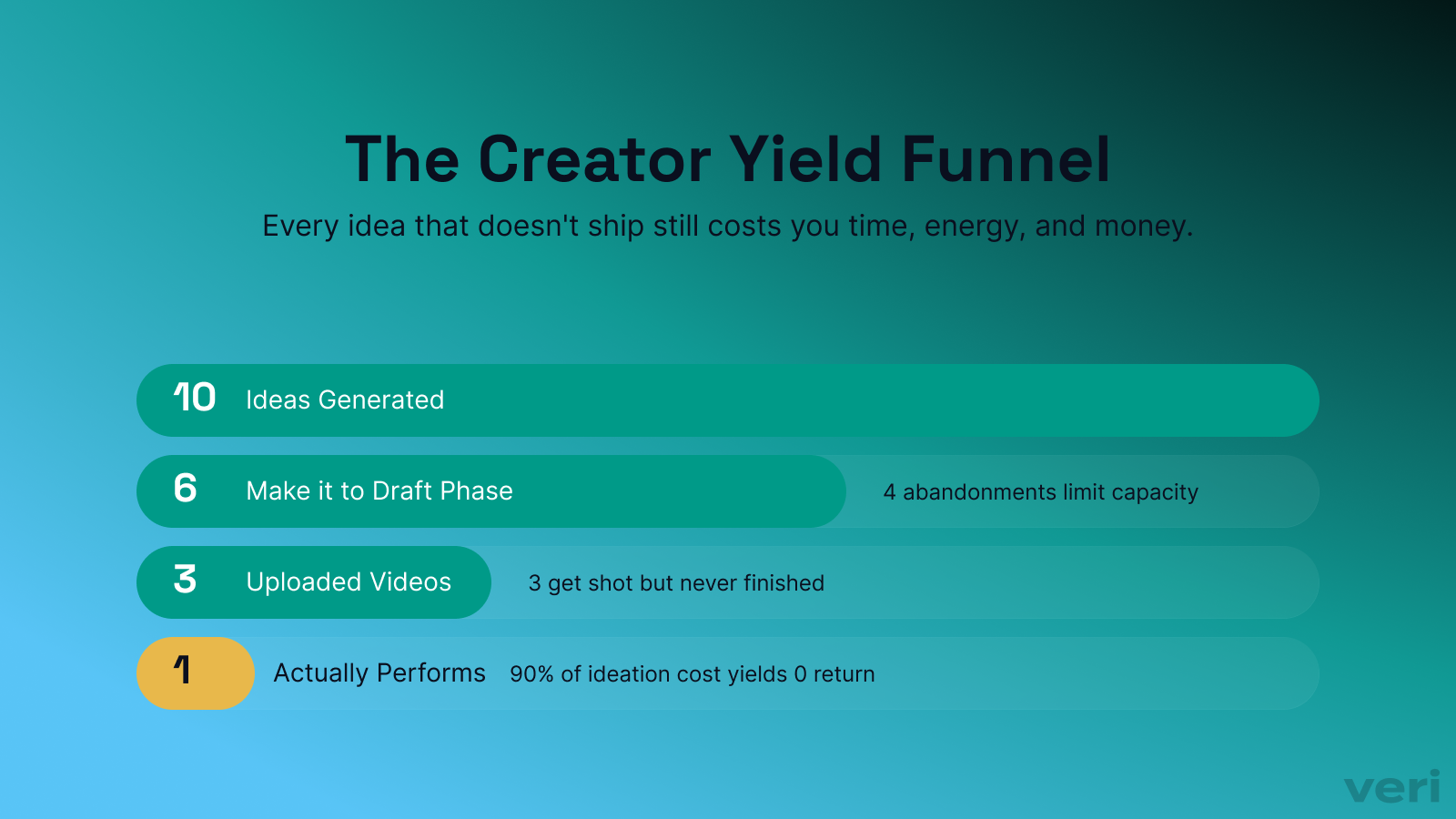
A creator starts with 10 ideas this week. Maybe 6 make it to a draft. 4 get shot. 3 get uploaded. 1 actually performs.
That creator paid for all 10. Time researching. Energy brainstorming. Hours drafting outlines that went nowhere. Every idea that didn’t ship still costs something. Every video that flopped still took a full production cycle.
You only get value from the ones that land.
Here’s what that looks like at scale:
| Metric | Low-Yield Creator | High-Yield Creator |
|---|---|---|
| Ideas started per week | 10 | 10 |
| Ideas that perform | 1 | 3 |
| Yield | 10% | 30% |
| Annual ideas started | 520 | 520 |
| Annual performing videos | 52 | 156 |
| Cost per performing video (in hours, energy, opportunity) | 10x | 3.3x |
| Δ Difference | +104 performing videos from the same effort |
Put differently: at 30% yield, each winner costs you about 33 hours of total production time. At 70% yield, it’s 14.
This isn’t about making more. It’s about losing less of what you already make.
Why this is a burnout problem.
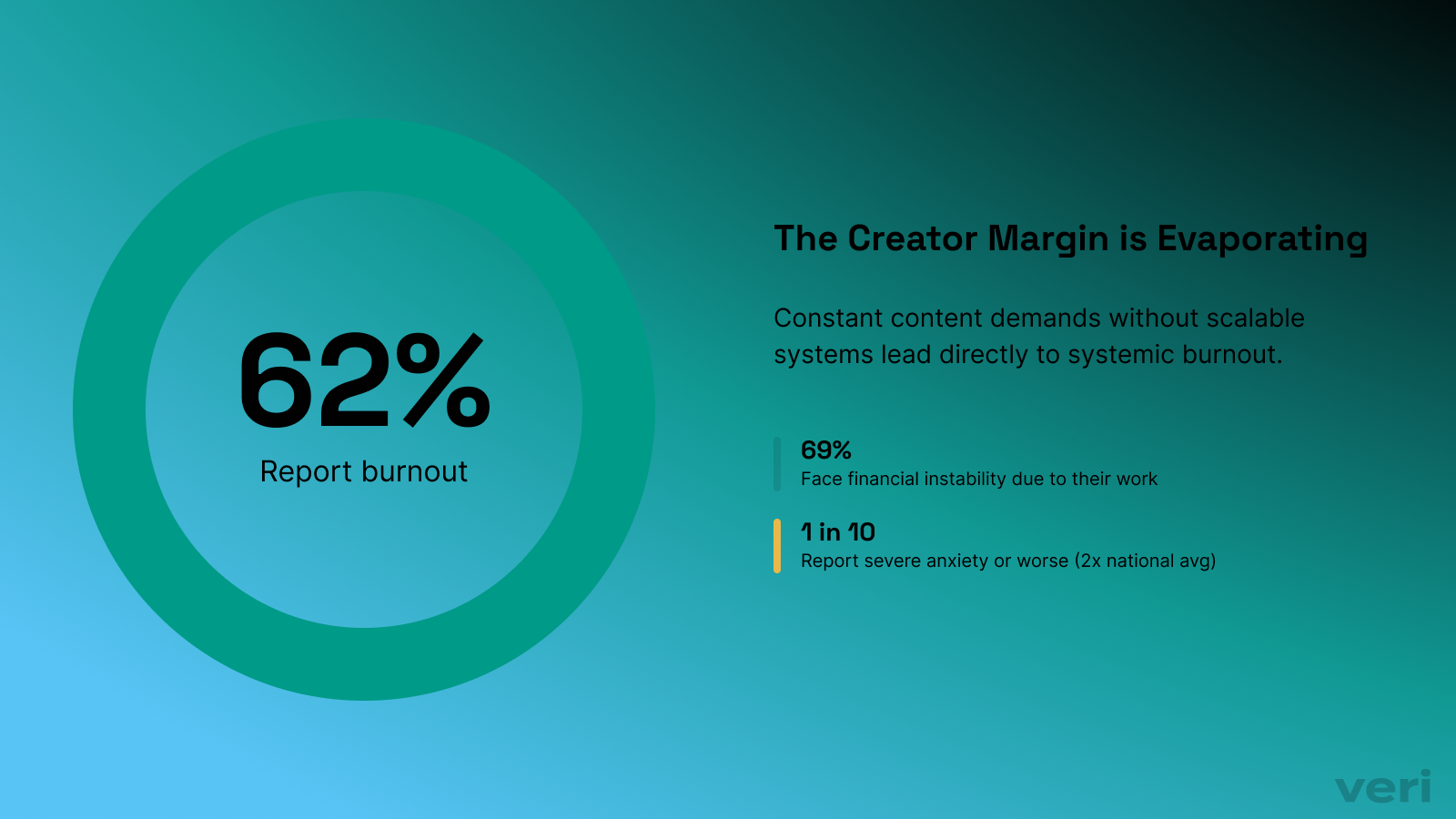
62% of creators report experiencing burnout. 69% face financial instability as a direct result of their work. More than half report anxiety. One in ten report having dark thoughts related to their work. Nearly twice the rate seen among U.S. adults overall.¹
The conversation usually stops at “take breaks” and “set boundaries.”
But burnout isn’t just about working too much. It’s about working on the wrong things and not knowing which ones those are until it’s too late.
A global study of 1,000 creators found creative fatigue is the number one cause of burnout at 40%, followed by demanding workloads at 31% and constant screen time at 27%.² One creator in the study said it plainly: “I’ve come up with hundreds, if not thousands, of video ideas. That’s emotionally exhausting. And the algorithm is inconsistent. Your success depends on something you can’t control.”²
That’s the yield problem wearing different clothes. Every bad call, every idea that goes nowhere, every draft that dies in a Google Doc. Those are all units that failed on the line, and the creator is paying full price for every one of them.
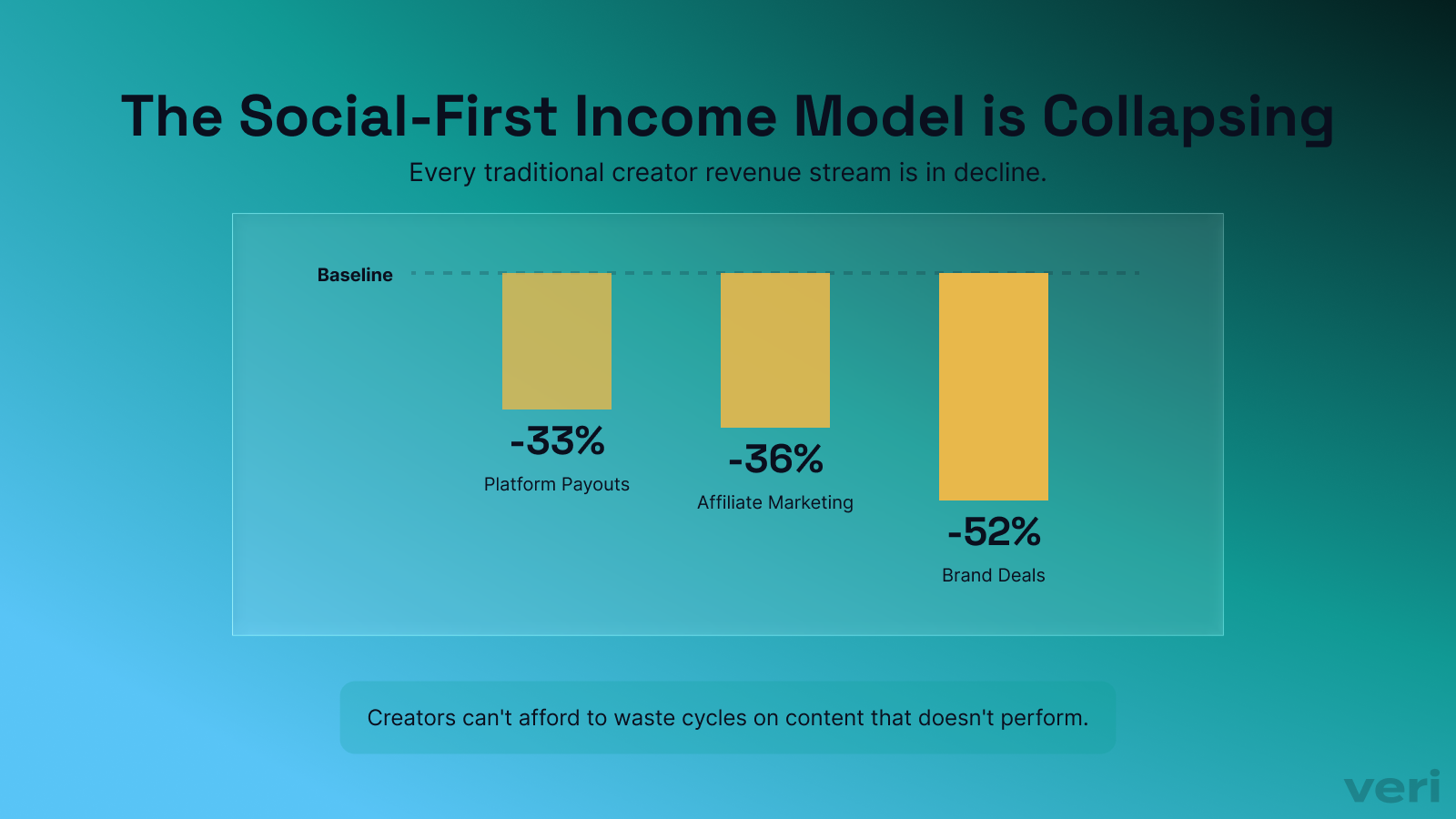
The financial pressure makes it worse. The social-first income model is collapsing: platform payouts down 33%, affiliate marketing revenue down 36%, and brand deals down 52%.³
The answer most AI tools offer: make more, faster. That’s GM logic. It makes the burnout worse, not better.
Too many decisions, not enough good ones.
A study of 14,000 people across 17 countries found that 74% say daily decisions have increased 10x in three years. 70% have given up on a decision entirely because the data was too overwhelming.⁴
Now put a creator in that context. Every day is a sequence of production decisions: what to make, what format, what hook, what thumbnail, when to post, which platform. 59% believe they need to post at least once a day.⁵ 63% feel pressure to post daily, with TikTok creators reporting burnout rates of 88%.⁶
You can’t increase output frequency AND maintain decision quality AND avoid burnout. What you can do is improve yield.
Most idea tools respond to this by giving you more options. vidIQ generates 50 ideas a day — 1,500 a month.⁷ 1of10 promises “tons of ideas and thumbnail concepts” at the click of a button.⁸ That’s the opposite of what helps.
You don’t improve yield by producing more units. You improve it by making each unit more likely to succeed before it hits the line. For creators: don’t generate more ideas. Generate fewer, better ones. Ones already informed by what works on your channel, for your audience, in your niche.
This is what people mean when they say “AI slop.” It’s not that AI is inherently bad. It’s that AI without context produces volume without taste.
You already have good ideas. The problem is every tool on the market burying them under 1,500 more.
Your brain is lying to you about ideas.
Most creators quit ideation exactly when it’s about to get good.
Researchers at Cornell and Northwestern studied how people come up with ideas. They called what they found the “creative cliff illusion.”⁹
The short version: everyone thinks their best ideas come first. The data says the opposite.
Your first few ideas come fast. That feels productive. Then the pace slows down, it gets harder, and your brain reads that difficulty as a signal to stop. But the ideas showing up in that slower phase are usually more original and more useful than the easy ones.⁹
Here’s what that costs you: the more strongly someone believed their creativity drops off over time, the sooner they quit. They spent less time on the task, came up with 12% fewer ideas, and 18% fewer good ideas.⁹
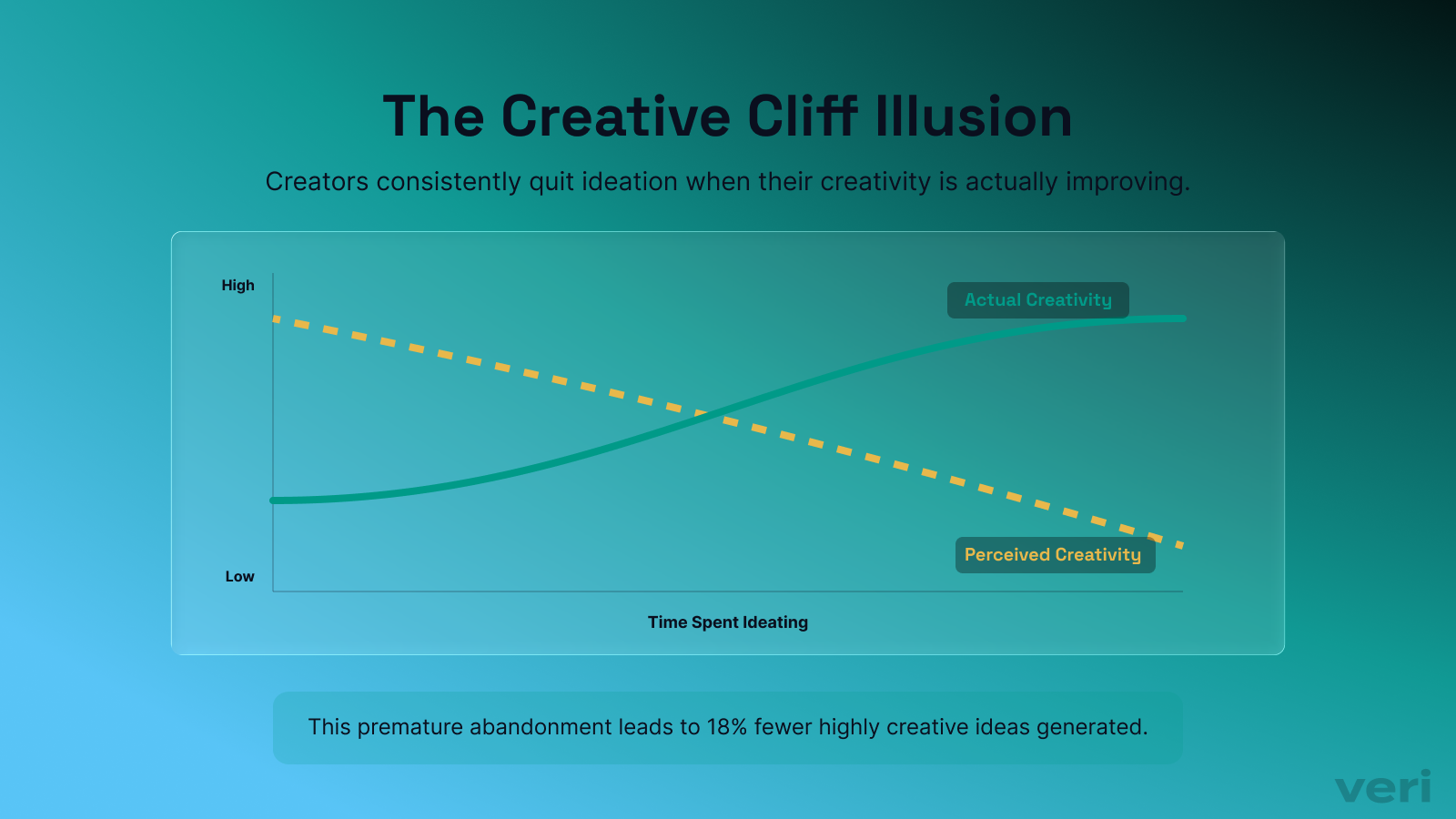
Creators are stopping the brainstorm right when it’s about to get good because their brain is telling them it’s already over.
The fix is surprisingly simple. The effect was weaker among people who create regularly, and it could be corrected just by telling people it exists. Knowing about the illusion changed how people worked and improved what they made.⁹
So the way most tools present ideas to creators, dump 50 options and let them pick, is built to trigger the exact mistake that kills creative output.
What yield improvement actually looks like.
What if a creator could start fewer ideas and have more of them land?
Not work harder, not hustle more. Just waste less.
10 ideas become 8 good drafts become 6 shoots become 5 uploads become 3 that perform. Same creator. Same hours. Fewer dead ends.
And it compounds. There’s a pattern that shows up everywhere from solar panels to aircraft manufacturing: the more you produce through a system that tracks what works, the cheaper each unit gets over time.¹⁰¹¹ Not because the inputs change, but because the system gets smarter about what to do with them.
The creator version: every video you ship through a system that learns from your data makes the next one easier. Not because you cut corners, but because the system is working for you. Video 100 takes less mental effort than video 10. Your best-performing formats surface faster. Your dead ends shrink.
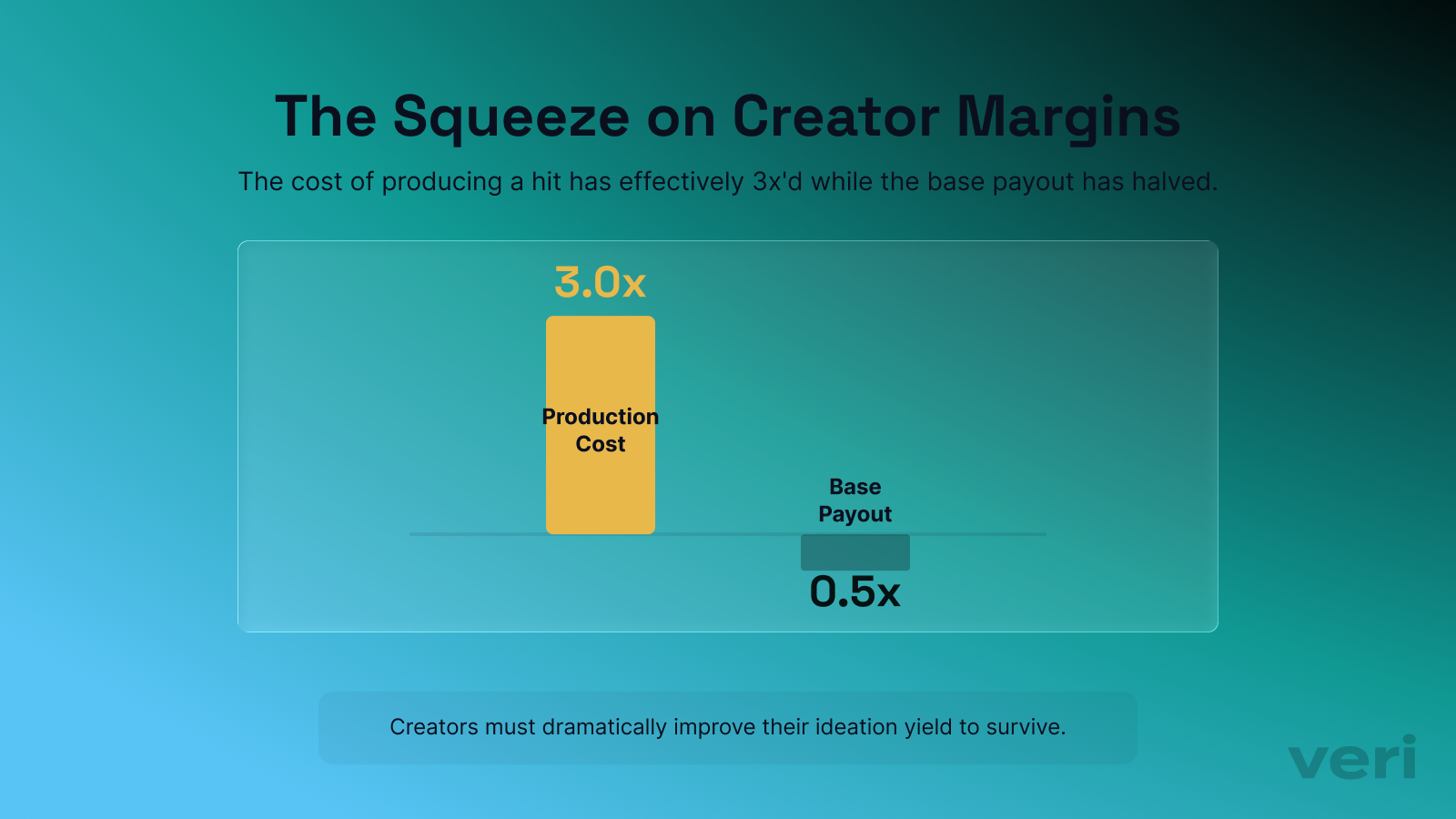
This is also why point solutions don’t work. If your creative process has six steps and each runs at 80%, your overall yield isn’t 80%. It’s 0.8⁶ = 26%. Only a system that sees your whole process can improve the whole thing.
That’s how the best creators pull away. It’s not that they have better instincts right now. It’s that their improvement rate is steeper. They’re learning faster because they have systems doing the pattern recognition they don’t have time to do manually.
The goal isn’t “produce more content.” It’s “stop spending your best creative energy on ideas that were never going to work.”
86% of creators already use AI. The tools are the problem.
86% of creators now actively use generative AI.¹² But adoption isn’t satisfaction. Most are stitching together ChatGPT for brainstorming, Canva for design, and various editors — none of which know their channel, their audience, or their performance data.¹²
And the creators who’ve resisted AI entirely? Their instinct isn’t wrong. Most AI tools do produce generic output. When every creator feeds the same prompt into the same model, the internet fills up with content that sounds the same, looks the same, and says nothing. That’s not a creator problem. That’s a tool problem.
The most telling finding: 85% of creators would consider using an AI agent that learns their creative style.¹² 70% are optimistic about agentic AI specifically.¹² The top desired capabilities are exactly what a yield engine provides: automating repetitive tasks (51%), brainstorming content ideas (50%), and surfacing content performance insights (44%).¹²
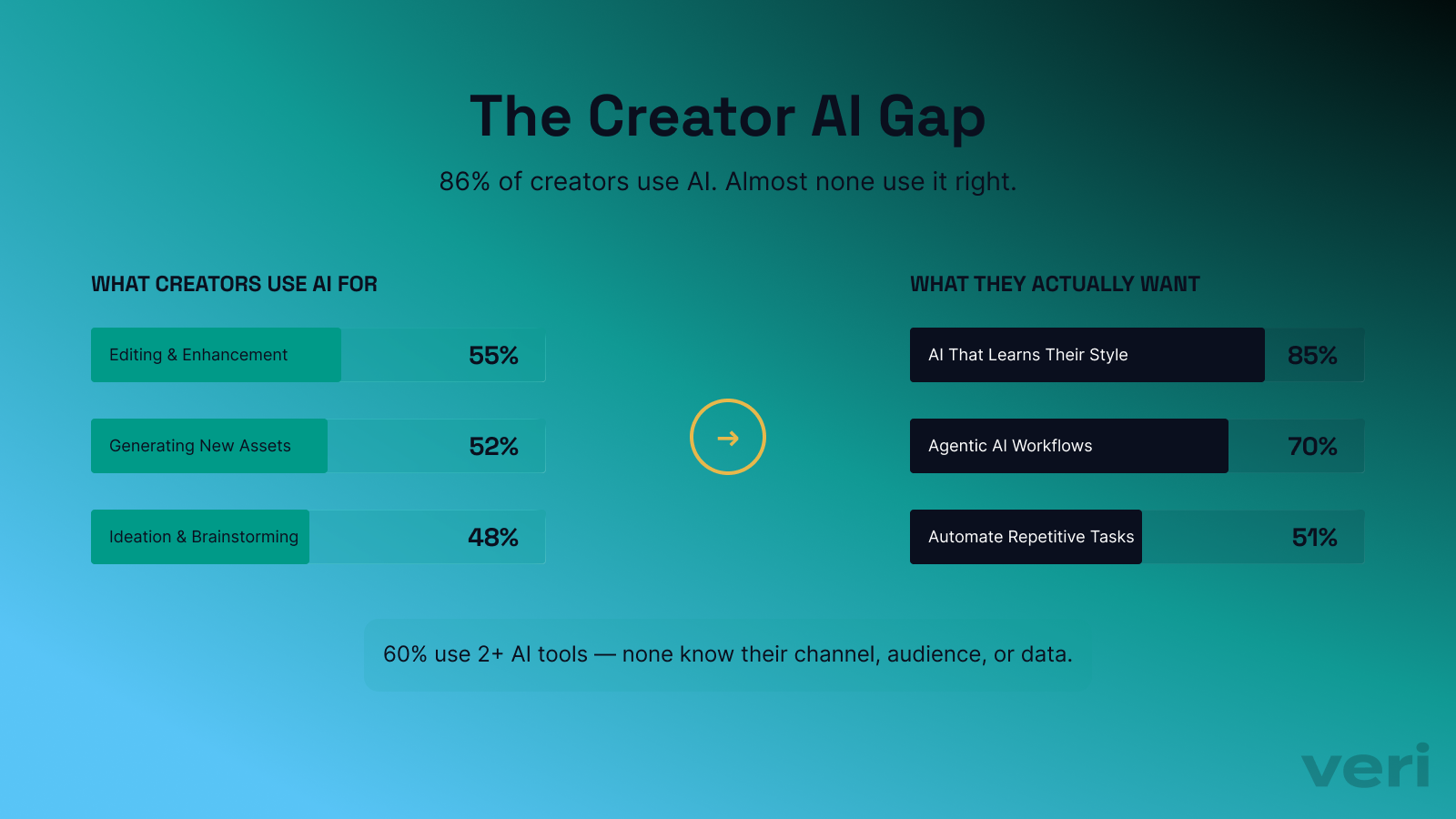
Creators don’t want less AI. They want AI that isn’t a slop machine.
The Ideas Agent is a yield engine.
We didn’t build an idea generator. We built a yield engine.
Pattern analysis. Most creators have signal buried in their own data and no time to find it. The Ideas Agent studies your best-performing content. Not the internet’s best content. Yours. It finds what’s quietly working across your videos: topics, formats, pacing, hooks.
Content DNA integration. Generic tools give generic ideas. Every recommendation from the Ideas Agent maps to your specific audience expectations, your proven formats, and your niche. Not what’s trending on the platform. What’s trending for you.
Trend scanning with context. It optionally scans web trends for timely angles. But only angles that map to your channel. Not generic “what’s trending” lists that have nothing to do with your content.
Single best output. It routes to multiple models, synthesizes 3-5 options internally and outputs one recommendation. Title, summary, rationale, approach. One recommendation with reasoning.
The key word is single. Because the creative cliff illusion research proves that reducing choices is how you reduce waste.⁹ Presenting fewer, higher-confidence options bypasses the cognitive failure mode that causes creators to abandon ideation prematurely. That’s not a UX decision. It’s a yield intervention.
The goal isn’t to automate your creativity. It’s to remove the noise around it so you can do the part only you can do: make something worth watching.
The Ideas Agent handles the front of the funnel. Scripts, thumbnails, packaging are different problems with different tools, and different stages in the system we’re building. But ideation is the most powerful point of failure or success. It’s where yield matters most.
The number nobody tracks.
The most important metric in the creator economy that nobody measures: yield. The ratio of ideas started to outcomes that perform.
Brands measure conversion rates down to the decimal. ecommerce companies obsess over cart abandonment. SaaS teams track activation funnels daily.
Creators measure views and subscribers. They measure the output. Almost nobody measures the input waste.
The creator economy is projected to reach $500 billion by 2030. There are over 400 million creators worldwide.¹³ The infrastructure to help them create, distribute, and monetize is massive and growing.
Nobody has built the infrastructure to help them waste less.
You’re paying for every idea you start. You only get value from the ones that land.
That’s yield. And it’s the number that actually determines what running a channel costs.
Connect your channel at joinveri.co and see what the Ideas Agent finds in your data.
Frequently Asked Questions
What is creator yield?
Creator yield is the ratio of ideas started to outcomes that perform. A creator who starts 10 ideas a week and gets 1 performing video has a 10% yield. At 30% yield, the same effort produces 3x the results. Most creators measure views and subscribers but never measure the input waste. Yield is the number that actually determines what running a channel costs.
How is yield different from just being more productive?
Productivity means producing more. Yield means losing less of what you already produce. A creator at 10% yield who doubles their output still wastes 90% of their effort. A creator who improves yield from 10% to 30% triples their performing content from the same hours. The math works differently when you measure waste instead of speed.
What is the creative cliff illusion?
Researchers at Cornell and Northwestern found that people believe their best ideas come first and creativity declines over time. The data says the opposite. The ideas that show up after the initial burst are usually more original. Creators who believe the illusion quit ideation early, generate 12% fewer ideas, and 18% fewer good ones. Knowing about the illusion changes the outcome.
Why don't idea generators like vidIQ and 1of10 improve yield?
They give you more options, not better ones. vidIQ generates 50 ideas a day. 1of10 promises tons of ideas at a click. But the creative cliff research shows that reducing choices reduces waste. Dumping 50 generic options triggers the exact cognitive failure that kills creative output. You don't improve yield by producing more units. You improve it by making each unit more likely to succeed before it hits the line.
What does the Ideas Agent do differently?
The Ideas Agent studies your best-performing content, not the internet's. It maps recommendations to your audience, your formats, your niche. It routes to multiple models, synthesizes 3-5 options internally, and outputs one recommendation with reasoning. One, not fifty. Fewer choices, higher confidence, less waste.
How does yield compound over time?
Every video you ship through a system that learns from your data makes the next one easier. Your best-performing formats surface faster. Your dead ends shrink. The system gets smarter about what works for you, and your cost per performing video drops over time.
Is Veri trying to replace the creative process?
No. Every output is a draft for you to edit, reject, or throw away. Nothing auto-publishes. The Ideas Agent handles the top of the funnel so you can spend your creative energy on the part only you can do. The goal is to stop spending your best hours on ideas that were never going to work.